'/%3E%3Cpath d='M30 0v30M0 15h60' stroke='%23FFF' stroke-width='10'/%3E%3Cpath d='M30 0v30M0 15h60' stroke='%23C8102E' stroke-width='6'/%3E%3C/svg%3E)
ADNOC Approved First Aid Training in UAE: What It Means, Who Needs It & How to Verify a Provider
This blog explains what “ADNOC approved” first aid training means in the UAE, who needs it, what the one-day course covers, and how to verify a provider before booking. It also covers certificate validity (commonly two years) and introduces ABCON’s first aid program in Dubai, Abu Dhabi, and Ras Al Khaimah.
This blog explains what “ADNOC approved” first aid training means in the UAE, who needs it, what the one-day course covers, and how to verify a provider before booking. It also covers certificate validity (commonly two years) and introduces ABCON’s first aid program in Dubai, Abu Dhabi, and Ras Al Khaimah.
ADNOC approved first aid training is a first aid course delivered by a provider that ADNOC or the relevant ADNOC Group company accepts for site access and contractor compliance. It typically runs one day, covers CPR, AED use, bleeding control, burns, fractures, and choking, and produces a certificate that is commonly valid for two years. Because approval is granted per provider and can differ between ADNOC Group companies, always verify the provider's approval and your site's specific requirement before booking.
Why ADNOC Approval Matters for First Aid Training
If your workforce enters ADNOC sites, offshore facilities, or works as an ADNOC contractor, a generic first aid certificate may not be enough. Site access and contractor prequalification often depend on certificates from recognized, approved training providers.
In practical terms, using a non-approved provider can lead to:
Certificates rejected at site induction or during an audit
Delays in mobilizing crews to a project
Repeat training costs for the same employees
Gaps in your emergency response coverage on site
First aid is also not a box-ticking exercise. According to the American Heart Association, immediate CPR can double or triple a cardiac arrest victim's chance of survival. In remote industrial locations where ambulances take longer to arrive, trained colleagues are the first and sometimes only line of response.
What Does "ADNOC Approved" Actually Mean?
This is where many buyers get confused, so here is the straightforward version.
Approval is provider-specific. ADNOC and its Group companies (such as ADNOC Onshore or ADNOC Gas Processing) maintain their own lists or acceptance criteria for training providers. A course is "ADNOC approved" because of who delivers it, not only what it teaches.
It sits on top of regulatory accreditation. A credible provider should also hold the relevant emirate-level and awarding-body approvals, such as DCAS in Dubai or ACTVET in Abu Dhabi, plus an internationally recognized awarding body.
Requirements vary by company and contract. One ADNOC entity may specify a particular certificate type or validity period that another does not. Your contract or HSE team has the final word.
Practical tip: Ask your ADNOC project contact or HSE department which provider list or certificate standard applies to your scope of work before booking any course.
Who Needs ADNOC Approved First Aid Training?
Typically, these roles are expected to hold current certification:
Designated first aiders on ADNOC sites and contractor work fronts
HSE officers and safety supervisors responsible for site emergency response
Contractor and subcontractor workforce in oil and gas, construction, and industrial operations
Supervisors and team leaders managing crews in remote or high-risk areas
Security and facilities staff who may be first on scene
If you are unsure whether your role qualifies, a short call with your HSE manager usually settles it faster than guessing.
What the Course Covers
A one-day first aid course for workplace and industrial settings generally includes:
Scene safety and primary survey (DRABC): Danger, Response, Airway, Breathing, Circulation
CPR for adults, with child and infant awareness
AED operation: safe use of an automated external defibrillator
Bleeding control and wound care
Burns and scalds
Fractures, sprains, and spinal precautions
Choking response
Shock recognition and management
Heat exhaustion and heat stroke: especially relevant for outdoor UAE work (see our guide to the UAE Midday Break Law 2026)
Reporting and handover to emergency services
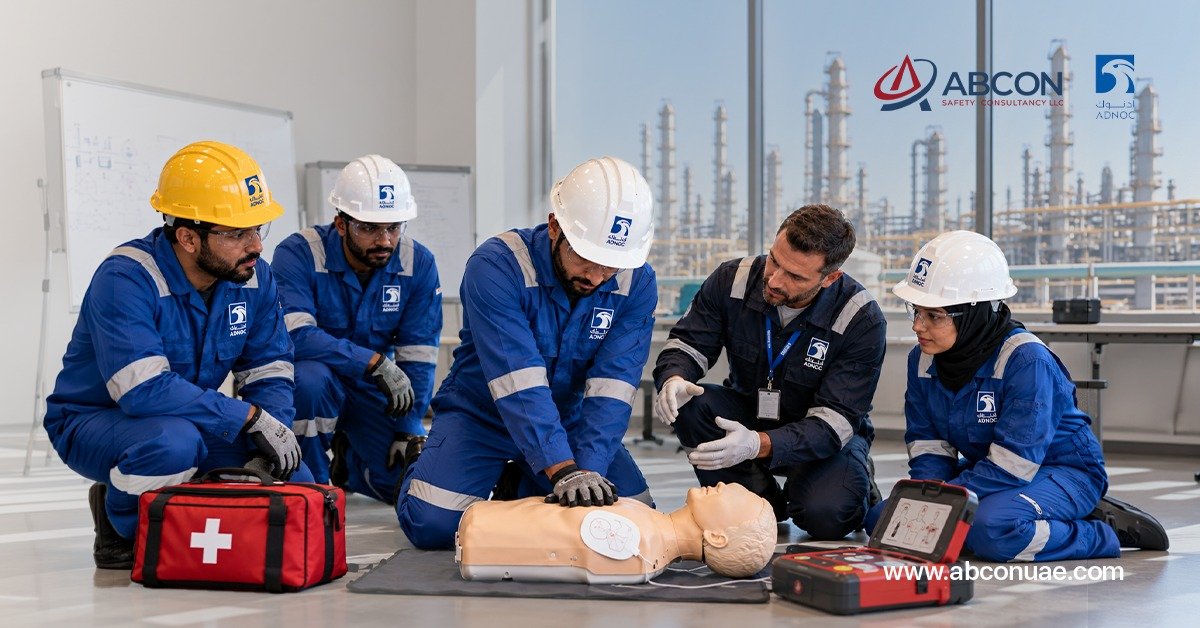
Quality training is practical. Look for hands-on CPR practice on manikins, AED trainers, and scenario-based assessment rather than a classroom lecture alone.
The UAE Regulatory Landscape You Should Know
ADNOC approval does not replace UAE regulation. It works alongside it.
Abu Dhabi (OSHAD-SF): The OSHAD System Framework Code of Practice 4.0 on First Aid and Medical Emergency Treatment sets expectations for first aiders to hold valid certification and for training providers to be accredited by an internationally recognized body.
Dubai (DCAS): The Dubai Corporation for Ambulance Services authorizes establishments to deliver first aid training. Requirements include accreditation from the awarding body, a suitably sized training room, training manikins, and defibrillators for practice.
Federal level (MOHRE): Employers have general duties to provide a safe workplace and emergency preparedness. See the UAE Government's workplace health and safety guidance.
For a broader view of how these pieces fit together, read our Complete Guide to Safety Compliance in the UAE.
7-Point Checklist: How to Verify an ADNOC Approved First Aid Provider
Do not rely on a banner claim. Check these seven things:
Written confirmation of ADNOC approval that names the specific ADNOC entity or scope
DCAS authorization (Dubai) and ACTVET approval (Abu Dhabi), where applicable
Awarding body accreditation (for example Highfield, HABC, AHA, or equivalent)
Certificate verification: can an employer confirm a certificate online or by reference number?
Qualified instructors with real emergency response or occupational health experience
Practical assessment included, with manikins and AED trainers
Clear certificate details: issue date, expiry date, course title, and awarding body printed on the certificate
For more on vetting any safety provider, see our guide on how to choose the right HSE training provider in the UAE.
Certificate Validity and Renewal
Workplace first aid certificates are commonly valid for two years, although some programs specify three. The validity printed on your certificate is what counts.
Refresher training should be completed before expiry so there is no gap in coverage on site.
Some clients require refreshers sooner after a policy change or incident.
Tip for employers: Keep a simple tracker of first aider names, certificate dates, and expiry dates. A six-month reminder avoids last-minute scrambles before a mobilization.
Comparison: Generic vs ADNOC Approved First Aid Training
Factor | Generic First Aid Course | ADNOC Approved First Aid Course |
|---|---|---|
Accepted for ADNOC site access | Not guaranteed | Intended for ADNOC requirements |
Provider vetting | Varies widely | Provider approved by ADNOC/relevant entity |
Typical duration | Half-day to 1 day | Commonly 1 day |
Practical assessment | Sometimes optional | Expected |
Best for | General community or office use | Contractors and staff working on ADNOC projects |
How ABCON Delivers First Aid Training
ABCON Safety Consultancy delivers one-day first aid programs in Dubai, Abu Dhabi, and Ras Al Khaimah. Our First Aid Training page lists our ADNOC, ACTVET, DCAS, TRAKHEES, and RAKEZ approvals, and our programs cover:
Basic First Aid
CPR and AED
Pediatric First Aid
Our approach is built around practical competence:
Hands-on practice with manikins and AED trainers
Experienced trainers with emergency response backgrounds
On-site or in-center delivery to suit your project schedule
Verifiable certificates you can confirm through our certificate verification page
You can review our full list of approvals on the Accreditations page. For more on the Dubai side of approvals, read our post on DCAS approved first aid training in the UAE.
The Business Case: First Aid Is Cheaper Than an Incident
Training costs are small compared to the cost of an unmanaged emergency. Workplace accidents trigger compensation, medical costs, lost productivity, project delays, and reputational damage. Our analysis in The Real Cost of Workplace Accidents in the UAE breaks down these costs and why prevention pays. Trained first aiders reduce the severity of injuries in the critical minutes before professional help arrives.
Common Mistakes to Avoid When Booking
Over years of supporting UAE contractors, the same avoidable problems keep appearing:
Booking on price alone. The cheapest course is expensive if the certificate is rejected at the gate.
Assuming one approval covers everything. A DCAS or ACTVET approval does not automatically satisfy an ADNOC Group company's own requirement.
Leaving renewals too late. Expired certificates can stop a crew from mobilizing.
Skipping the practical element. Auditors and site managers value demonstrated competence, not attendance alone.
Not matching course level to role. Designated first aiders and supervisors may need a fuller program than general staff awareness.
A short conversation with your provider before booking usually prevents all five.
Frequently Asked Questions
What is ADNOC approved first aid training?
It is first aid training delivered by a provider accepted by ADNOC or an ADNOC Group company, usually required for contractors and staff working on ADNOC sites.
How long is the course?
A standard workplace course typically takes one day, including practical CPR, AED, and first aid skills.
How long is the certificate valid?
Commonly two years, though some programs specify three. Check the expiry date printed on your certificate.
Is a DCAS or ACTVET certificate enough for ADNOC sites?
Not always. Emirate-level approval shows regulatory standing, but ADNOC entities may apply their own provider requirements. Confirm with your project HSE contact.
Can I do first aid training online only?
Online theory can support learning, but first aid is a hands-on skill. Most site requirements expect practical, instructor-led assessment.
Do I need separate CPR training?
CPR and AED are normally included in a first aid course. Our First Aid Training page explains how the modules fit together.
How do I verify my provider's ADNOC approval?
Ask for written confirmation naming the ADNOC entity and scope, check emirate-level approvals, and confirm the certificate can be verified by reference number.
Get Your Team ADNOC-Ready
Choosing the right provider saves time, avoids rejected certificates, and puts genuinely capable first aiders on your site. If you need approved first aid training in Dubai, Abu Dhabi, or Ras Al Khaimah, view ABCON's First Aid Training program or explore all training courses.