'/%3E%3Cpath d='M30 0v30M0 15h60' stroke='%23FFF' stroke-width='10'/%3E%3Cpath d='M30 0v30M0 15h60' stroke='%23C8102E' stroke-width='6'/%3E%3C/svg%3E)
What is HSE Training? A Complete Guide for UAE Workplaces in 2026
The blog explains what HSE training is, why it's legally required in the UAE, who needs it, and what topics it covers. It compares HSE, First Aid, and Fire Fighting training, gives tips on choosing the right provider, and ends with an FAQ section. Throughout, it naturally links to ABCON's training, inspection, accreditation, and contact pages to drive traffic and conversions.
The blog explains what HSE training is, why it's legally required in the UAE, who needs it, and what topics it covers. It compares HSE, First Aid, and Fire Fighting training, gives tips on choosing the right provider, and ends with an FAQ section. Throughout, it naturally links to ABCON's training, inspection, accreditation, and contact pages to drive traffic and conversions.
Workplace safety isn't optional in the UAE it's a legal, moral, and operational obligation. Whether you manage a construction site in Abu Dhabi, a warehouse in Dubai, or a facility in a free zone, HSE training is the foundation that keeps your workforce protected and your business compliant.
But what exactly is HSE training? Who needs it? And how do you choose the right program in 2026?
This complete guide answers all of that.
What Does HSE Stand For?
HSE stands for Health, Safety, and Environment. It is a discipline that focuses on:
Protecting workers from physical harm, illness, and accidents
Reducing environmental impact from workplace activities
Ensuring compliance with local and international safety regulations
In the UAE context, HSE frameworks are shaped by federal labour laws, emirate-level regulations, and standards from authorities such as Dubai Municipality, Abu Dhabi Municipality (ADM), TRAKHEES, and civil defence bodies across the country.
What is HSE Training?
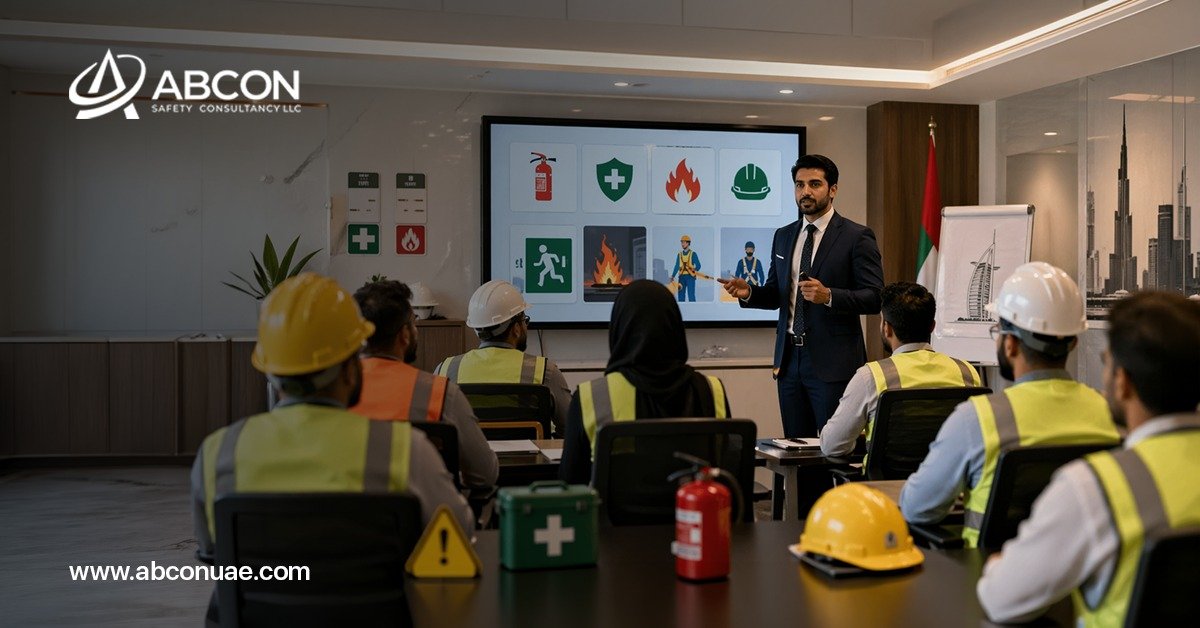
HSE training is structured, accredited education that equips workers and managers with the knowledge, skills, and awareness to identify hazards, control risks, respond to emergencies, and operate safely in their working environment.
It is not a one-time orientation. Effective HSE training is ongoing, role-specific, and tied to recognised certifications that are respected by UAE regulatory authorities.
Our HSE Training programme at ABCON covers everything from hazard identification and risk assessment to incident reporting and emergency response all delivered in a single intensive day with a formal certificate provided upon completion.
Why is HSE Training Important in UAE Workplaces?
The UAE has significantly strengthened its workplace safety enforcement over the past decade. Here is why HSE training matters more than ever in 2026:
Legal compliance: UAE Federal Law No. 8 of 1980 (Labour Law) and its amendments mandate that employers provide safe working conditions. Failure to comply can result in fines, project shutdowns, or loss of licences.
Accident prevention: Most workplace accidents are preventable. HSE training directly reduces the likelihood of incidents by building safety awareness into daily behaviour.
Regulatory inspections: Authorities, including ADM-approved third party inspectors, regularly evaluate safety compliance on site. Trained teams perform better during audits.
Insurance and liability: Businesses with certified HSE programmes often benefit from better insurance terms and face fewer liability claims.
Worker morale and retention: Employees who feel safe at work are more productive and less likely to leave.
Who Needs HSE Training in the UAE?
HSE training is relevant across virtually every sector. The following roles and industries particularly require it:
By role:
Site supervisors and project managers
Safety officers and HSE coordinators
Warehouse and logistics staff
Maintenance and technical personnel
Frontline workers in high-risk environments
By industry:
Construction and civil engineering
Oil, gas, and petrochemicals
Manufacturing and industrial facilities
Hospitality, retail, and food processing
Healthcare and pharmaceutical sectors
Ports, shipping, and offshore operations
If your team works with machinery, chemicals, heights, confined spaces, or any physical hazard — HSE training is not optional.
Core Topics Covered in HSE Training
A well-structured HSE training programme should cover the following areas:
Hazard Identification — recognising physical, chemical, biological, and ergonomic risks
Risk Assessment — evaluating severity and likelihood to prioritise controls
Personal Protective Equipment (PPE) — correct selection, use, and maintenance
Emergency Response — evacuation procedures, fire response, and emergency communication
Incident Reporting — near-miss reporting, investigation basics, and corrective actions
Safety Signage and Regulations — understanding UAE-specific safety standards
Environmental Awareness — minimising environmental impact from operations
Workplace Inspections — daily safety checks and toolbox talk fundamentals
HSE Training vs. First Aid vs. Fire Fighting Training
Many businesses confuse these three or assume one replaces the other. They are complementary:
Training Type | Focus | Duration |
|---|---|---|
HSE Training | Hazards, risk, compliance, safety culture | 1 Day |
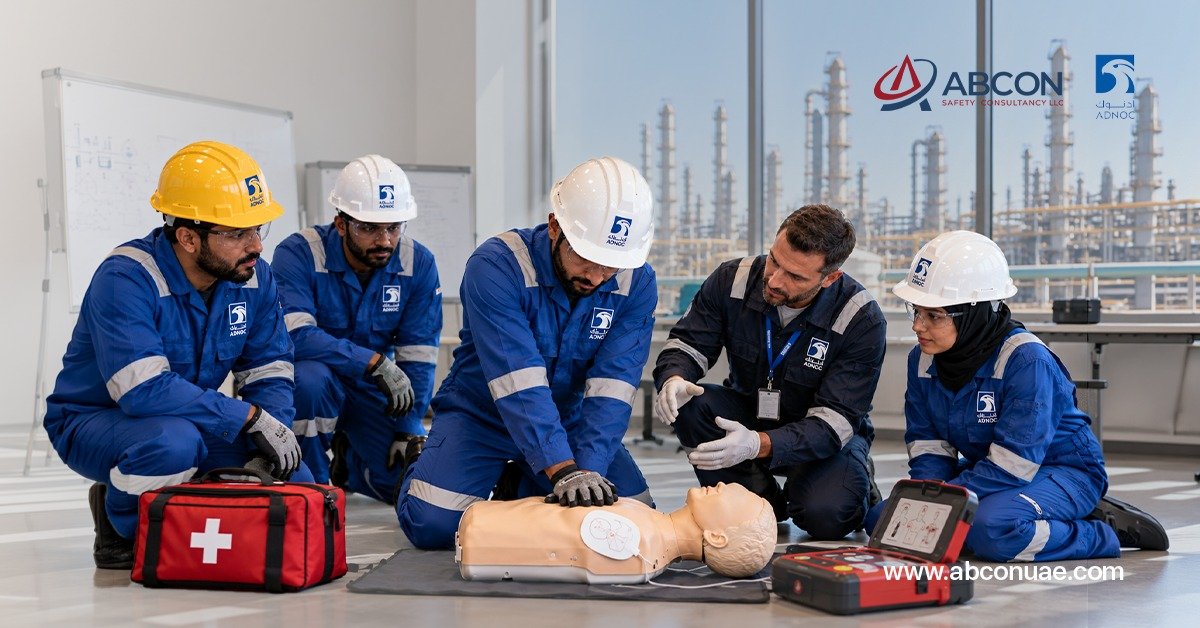
First Aid Training | Emergency medical response, CPR, AED use | 1 Day |
Fire Fighting Training | Fire prevention, extinguisher use, evacuation | 1–2 Days |
For full workplace compliance, many UAE employers enroll their teams across all three programmes.
How to Choose the Right HSE Training Provider in UAE
Not all training providers are equal. When evaluating your options, look for:
Accreditation from recognised bodies — KHDA, ACTVET, DCAS, Highfield, HSI, and others are the benchmarks in the UAE. At ABCON, we hold 15+ accreditations from leading UAE and international authorities.
Experienced, certified trainers — your instructor's background matters as much as the syllabus
UAE-specific regulatory knowledge — training should reflect local laws, not just generic global content
Certification validity — ensure the certificate issued is accepted by your project authority or free zone
Flexible scheduling — look for providers who can accommodate your team's operational hours
What Happens After HSE Training?
Training alone doesn't make a workplace safe it needs to be paired with ongoing safety management. After certification, employers should:
Conduct regular third party safety inspections to validate on-the-ground compliance
Schedule refresher training annually or whenever regulations change
Implement toolbox talks and daily safety briefings at the supervisor level
Maintain updated safety documentation for regulatory audits
Our team at ABCON supports businesses through the full safety lifecycle from initial training to independent inspection and consultancy.
Frequently Asked Questions (FAQs)
Q1. Is HSE training mandatory in the UAE?
Yes. UAE labour law requires employers to provide a safe working environment, which includes adequate safety training. Specific sectors — such as construction, oil and gas, and industrial facilities face stricter enforcement from relevant regulatory authorities.
Q2. How long does HSE training take?
Our HSE training programme is completed in a single day. You receive a formal certificate upon completion, making it one of the most time-efficient compliance steps your business can take.
Q3. Is the HSE training certificate valid across all UAE emirates?
This depends on the accrediting body. ABCON's certifications are backed by multiple UAE-recognised authorities, including KHDA, ACTVET, DCAS, and others, giving broad validity across emirates and free zones.
Q4. Can HSE training be conducted on-site at our facility?
Yes. ABCON offers flexible delivery options including on-site training for larger teams. Contact us to discuss a customised arrangement for your business.
Q5. How often should HSE training be renewed?
Best practice and increasingly a regulatory expectation is annual renewal. Industries with high hazard exposure should consider more frequent refresher programmes or sector-specific top-up training.
Q6. What is the difference between HSE training and NEBOSH?
HSE training covers foundational safety awareness and UAE compliance essentials and is completed in one day. NEBOSH is an internationally recognised qualification that requires several days of study and a formal examination. Both have value HSE training is ideal for the wider workforce, while NEBOSH suits safety professionals and managers seeking advanced credentials.
Ready to Get Your Team Certified?
Whether you're onboarding new employees, preparing for a regulatory audit, or building a stronger safety culture across your organisation, ABCON is equipped to help.
We are an accredited safety consultancy with over 10 years of experience serving businesses across the UAE, with 15,000+ professionals trained and 500+ clients served across every emirate.