'/%3E%3Cpath d='M30 0v30M0 15h60' stroke='%23FFF' stroke-width='10'/%3E%3Cpath d='M30 0v30M0 15h60' stroke='%23C8102E' stroke-width='6'/%3E%3C/svg%3E)
Why Fire Safety Inspections Are Essential
Explains why fire safety inspections matter for UAE businesses covering 6 key reasons (preventable risks, functioning life-safety systems, Civil Defence compliance, insurance validity, evacuation route integrity, lease requirements). Details a 7-part inspection scope, a frequency table by facility type, EIAC accreditation, a checklist, 5 FAQs, and a CTA to book an inspection.
Explains why fire safety inspections matter for UAE businesses covering 6 key reasons (preventable risks, functioning life-safety systems, Civil Defence compliance, insurance validity, evacuation route integrity, lease requirements). Details a 7-part inspection scope, a frequency table by facility type, EIAC accreditation, a checklist, 5 FAQs, and a CTA to book an inspection.
Introduction
Most workplace fires trace back to something that was fixable well before it became dangerous — a blocked fire exit, an expired extinguisher, a fault in the alarm system, or an overloaded circuit that nobody flagged. Fire safety inspections exist precisely to catch these issues while they're still a maintenance item, not an emergency.
For UAE businesses, fire safety inspection isn't a discretionary precaution it's tied directly to Civil Defence approval, insurance validity, and basic legal responsibility for occupant safety. Yet many facility managers only think seriously about fire safety compliance when a lease renewal, insurance audit, or Civil Defence inspection forces the issue. This guide explains why fire safety inspections matter, what a proper inspection actually covers, and how often UAE facilities should be scheduling one.
What Is a Fire Safety Inspection?
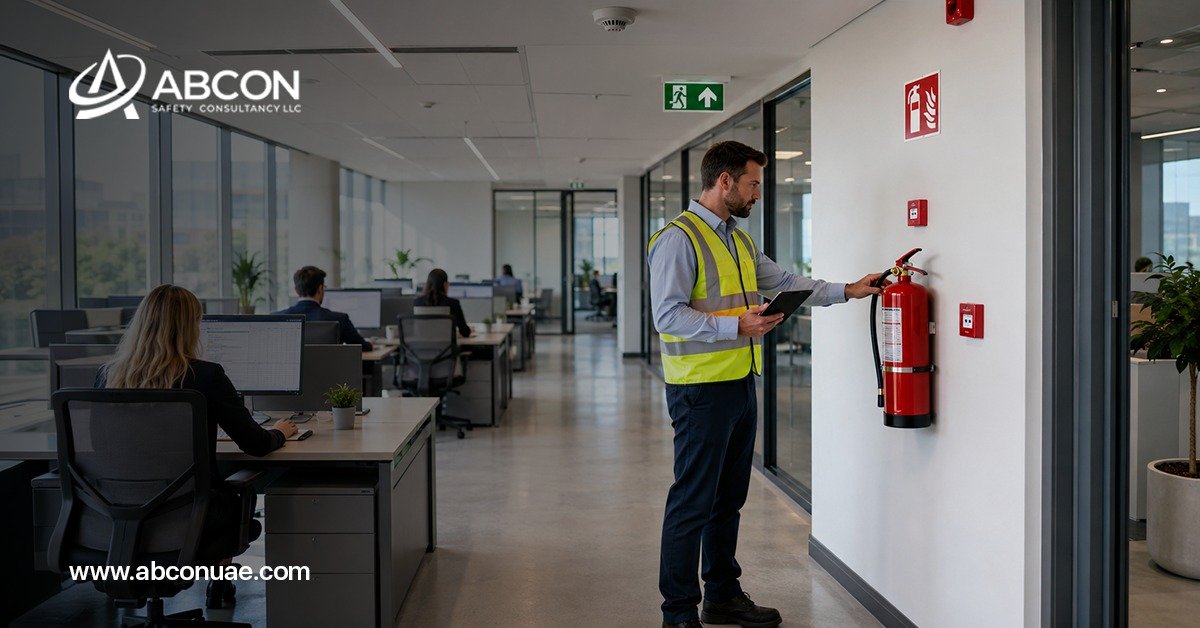
A fire safety inspection is a structured assessment of a building's fire prevention, detection, and response systems, along with the physical conditions that affect fire risk and safe evacuation. It covers everything from fire alarm functionality to extinguisher placement, evacuation route accessibility, and compliance with UAE Civil Defence fire and life safety codes.
The purpose isn't just to identify existing violations it's to catch developing risks (a partially blocked exit, a degraded fire door seal, an extinguisher past its service date) before they compromise a building's ability to detect and respond to a real fire event.
Why Fire Safety Inspections Are Essential
1. Most Fire Risks Are Preventable, Not Random
Fires in commercial and industrial buildings are rarely the result of unavoidable bad luck — they typically stem from identifiable, correctable issues: electrical faults, blocked ventilation, improperly stored flammable materials, or degraded fire suppression equipment. Regular inspection catches these issues while they're still fixable.
2. Life Safety Depends on Functioning Systems
Fire alarms, sprinkler systems, and emergency lighting only work if they're actually maintained and tested. A building can have every required system installed and still fail to protect occupants if those systems have quietly stopped functioning correctly.
3. Civil Defence Compliance Is a Legal Requirement
UAE Civil Defence authorities require commercial and high-occupancy buildings to meet defined fire and life safety standards, with documented inspection forming a core part of demonstrating ongoing compliance, not just a one-time approval at building handover.
4. Insurance Coverage Frequently Depends on It
Many UAE insurers treat current fire safety inspection and compliance certificates as a condition of coverage, and a lapsed inspection can complicate or invalidate a claim following a fire-related incident.
5. Evacuation Routes Degrade Over Time Without Oversight
Storage decisions, furniture rearrangement, and daily operational changes can gradually compromise evacuation routes and exit accessibility in ways that aren't obvious during normal use but become critical during an actual emergency.
6. Insurance and Contractual Requirements Reinforce the Standard
Beyond Civil Defence requirements, many commercial leases and contracts require tenants to maintain documented fire safety compliance as a condition of occupancy, tying inspection directly to a business's ability to legally operate from its premises.
What a Professional Fire Safety Inspection Includes
Fire alarm and detection system testing — verifying smoke detectors, heat detectors, and alarm panels function correctly and are appropriately positioned
Fire suppression system checks — inspecting sprinkler systems, fire extinguishers, and hose reels for service currency and correct placement
Emergency lighting and signage verification — confirming emergency lighting activates correctly and exit signage remains visible and unobstructed
Evacuation route assessment — checking that exits, corridors, and stairwells remain clear, accessible, and correctly marked
Fire door and compartmentation checks — verifying fire doors close properly and maintain their fire-rated seal integrity
Electrical and ignition source review — identifying overloaded circuits, damaged wiring, or improperly stored flammable materials that increase fire risk
Documented inspection report — a formal report classifying findings by severity, with clear remedial timelines suitable for Civil Defence and insurance submission
An inspection conducted by an EIAC-accredited safety consultancy ensures the resulting report is recognized by Civil Defence, insurers, and auditors an informal internal check may catch obvious issues but won't carry the same regulatory standing.
How Often Should Fire Safety Inspections Be Conducted?
Facility Type | Recommended Frequency |
|---|---|
Commercial offices and retail | Annually, aligned with Civil Defence renewal cycles |
Hotels and hospitality | Annually, with more frequent fire alarm testing |
Industrial and manufacturing facilities | Annually, or more frequently for high-hazard areas |
High-occupancy buildings (malls, entertainment venues) | Annually, with quarterly system function checks |
Construction sites | Quarterly, or per phase change |
Following any building modification or fit-out | Immediately after the work is completed |
Facilities with higher occupancy density, flammable material storage, or a history of compliance findings should default to more frequent inspection rather than the minimum interval.
Best Practices Checklist Before Booking a Fire Safety Inspection
Confirm the provider is EIAC-accredited and recognized for Civil Defence-relevant fire safety inspection
Ensure the inspection covers detection, suppression, evacuation routes, and fire doors — not a partial check
Request a report suitable for Civil Defence submission and insurance documentation
Verify fire extinguisher and suppression system service dates are current
Confirm evacuation routes and exit signage are clear and unobstructed at the time of inspection
Set a recurring annual (or more frequent) inspection schedule rather than a reactive one
Train staff on basic fire safety awareness alongside formal system inspection
Frequently Asked Questions
1. Is fire safety inspection legally required in the UAE?
Yes, in substance. Civil Defence authorities require commercial and high-occupancy buildings to maintain compliant fire and life safety systems, and documented inspection is generally required to support ongoing approval and occupancy compliance.
2. How long does a fire safety inspection typically take?
Duration depends on building size and system complexity, but a standard commercial premises inspection typically takes a few hours, while larger facilities with multiple systems can take a full day or more.
3. What happens if a fire safety inspection identifies a critical issue?
Critical findings, such as a non-functional alarm system or blocked evacuation route, typically require immediate remedial action, sometimes including operational restrictions until the issue is resolved and verified through a follow-up inspection.
4. Does fire safety inspection cover fire extinguisher servicing, or is that separate?
A comprehensive fire safety inspection typically includes checking that extinguishers are correctly placed and within their service date, though the physical servicing and recharging of extinguishers is often carried out as a related but distinct maintenance activity.
5. Is a fire safety inspection certificate required for insurance claims in the UAE?
Many UAE insurers request evidence of current, valid fire safety inspection documentation when processing claims related to fire incidents, making up-to-date inspection an important part of maintaining valid coverage.
Final Thoughts: Prevention Costs Less Than Recovery
A fire safety inspection is one of the most cost-effective risk management investments a UAE business can make, precisely because the alternative an undetected fault escalating into an actual fire carries costs that dwarf the price of routine inspection many times over. Regular, documented inspection turns fire risk from an unpredictable threat into a managed, budgeted maintenance item.
Ready to have your facility's fire safety systems inspected by an EIAC-accredited team?
Get in touch for a comprehensive fire safety inspection tailored to your building type and occupancy profile because the best fire is the one that never gets the chance to start.