'/%3E%3Cpath d='M30 0v30M0 15h60' stroke='%23FFF' stroke-width='10'/%3E%3Cpath d='M30 0v30M0 15h60' stroke='%23C8102E' stroke-width='6'/%3E%3C/svg%3E)
Incident Investigation Training UAE: How to Find Root Causes & Prevent Recurrence
Explains why surface-level incident reports don't prevent recurrence and how proper investigation training finds root causes instead.
Explains why surface-level incident reports don't prevent recurrence and how proper investigation training finds root causes instead.
Introduction
Most workplace incidents in the UAE get reported. Far fewer get properly investigated. There's a meaningful difference between filling out an incident form that says "employee slipped near the loading dock" and running a structured investigation that uncovers why the floor was wet, why the drainage issue was never fixed, and why three near-misses in that same spot were never escalated before someone actually got hurt.
That gap between reporting and genuine root cause investigation is exactly where incident investigation training earns its value. Without it, safety teams fix symptoms, close the report, and watch the same incident happen again in a different form six months later. This guide explains what proper incident investigation involves, the root cause methodologies UAE safety teams should be trained in, and how to build an investigation process that actually prevents recurrence instead of just documenting it.
Why Most Incident "Investigations" Don't Actually Find the Cause
A common pattern in under-trained safety teams looks like this: an incident occurs, a report gets filed, the immediate cause gets identified (the floor was wet), a quick fix gets applied (a warning sign gets placed), and the file gets closed. Nobody asks why the floor was wet in the first place, why it had been wet before, or why the drainage or spill-response system failed to prevent it.
This is the difference between an immediate cause and a root cause and it's the single most important distinction incident investigation training teaches. Immediate causes explain what happened directly before the incident. Root causes explain the underlying system, process, or organizational failure that allowed the immediate cause to exist in the first place. Fixing only the immediate cause guarantees the underlying problem stays live, waiting for its next opportunity to cause harm.
Core Root Cause Analysis Methods Covered in Incident Investigation Training
1. The 5 Whys Technique
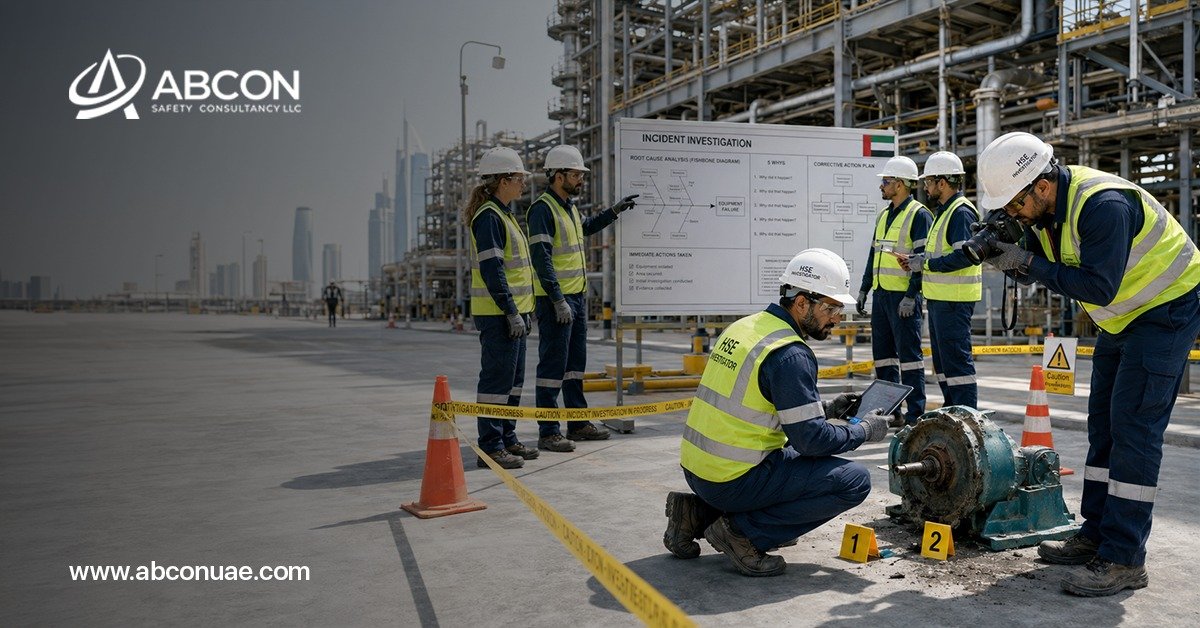
A structured questioning method where investigators repeatedly ask "why" typically five times moving from the immediate cause down through each contributing layer until they reach a genuine systemic root cause, rather than stopping at the first plausible explanation.
2. Fishbone (Ishikawa) Diagrams
A visual tool that organizes potential contributing factors into categories people, process, equipment, environment, and management — helping investigators map multiple contributing causes rather than fixating on a single explanation.
3. Fault Tree Analysis
A more technical, top-down method that maps the logical combination of events and conditions that had to occur together for the incident to happen, particularly useful for complex industrial or process safety incidents.
4. Barrier Analysis
An approach that examines which safety barriers (physical, procedural, or administrative) should have prevented the incident, and specifically why each one failed or was absent.
5. Human Factors Analysis
A structured look at whether fatigue, workload, training gaps, communication breakdowns, or procedural design contributed to human error, moving investigations away from simply blaming the individual involved.
A well-trained investigator doesn't rely on a single method by default they're trained to select the right tool based on incident complexity, from a straightforward 5 Whys analysis for a minor near-miss to a full fault tree analysis for a serious process safety event.
What Incident Investigation Training Should Cover
Immediate cause versus root cause identification
Evidence gathering and scene preservation techniques
Structured witness interviewing (avoiding leading questions and blame-driven framing)
Root cause analysis methodologies (5 Whys, fishbone, fault tree, barrier analysis)
Human factors and systemic contributing factors, beyond individual error
Writing clear, actionable investigation reports with defined corrective actions
Tracking corrective action closure and verifying effectiveness, not just implementation
Why Incident Investigation Training Matters for UAE Businesses
1. Prevents Recurrence, Not Just Documentation
Properly trained investigators identify the systemic issue behind an incident, meaning corrective actions address the actual cause rather than a surface symptom — directly reducing the likelihood of a repeat event.
2. Supports ISO 45001 and Broader HSE Compliance
Incident investigation and root cause analysis are core requirements within occupational safety management frameworks like ISO 45001, which expects organizations to demonstrate a structured, competent investigation process, not an informal one.
3. Reduces Legal and Insurance Exposure
A thorough, well-documented investigation demonstrates due diligence to regulators and insurers following a serious incident, while a superficial investigation can raise questions about an organization's genuine commitment to safety management.
4. Builds a Genuine Learning Culture
Investigations conducted without blame-driven framing encourage employees to report near-misses and hazards honestly, generating far more early-warning data than a culture where reporting feels like it invites punishment.
Building an Incident Investigation Process That Works
Immediate response and scene preservation — securing the area and gathering evidence before it degrades or gets disturbed
Structured interviews — speaking with witnesses individually, using open, non-leading questions
Root cause analysis — applying the appropriate methodology based on incident severity and complexity
Corrective action planning — defining specific, assigned, time-bound actions tied directly to root causes identified
Verification and closure — confirming corrective actions were implemented and are actually effective, not just marked complete
Trend analysis — reviewing investigation findings across multiple incidents over time to catch systemic patterns a single investigation might miss
Best Practices Checklist for Incident Investigation Training
Train investigators to distinguish immediate causes from root causes explicitly
Equip teams with at least one structured root cause methodology (5 Whys at minimum)
Train interview techniques that avoid blame-driven framing and leading questions
Require corrective actions to be specific, assigned, and time-bound
Build in a verification step to confirm corrective actions actually worked
Review investigation trends periodically to catch systemic, recurring issues
Reinforce a non-punitive reporting culture to encourage honest near-miss reporting
Frequently Asked Questions
1. What's the difference between an immediate cause and a root cause?
An immediate cause is the direct trigger of an incident (a wet floor, a missing guard), while a root cause is the underlying systemic failure that allowed that trigger to exist (a broken drainage system that was never repaired, an inspection process that missed the missing guard). Effective investigation training focuses on identifying and fixing the root cause, not just the immediate one.
2. Is incident investigation training required for ISO 45001 compliance?
While ISO 45001 doesn't specify a named training course, it does require organizations to demonstrate a competent, structured process for investigating incidents and identifying root causes, which in practice requires trained personnel capable of applying recognized methodologies.
3. Who in an organization should receive incident investigation training?
HSE officers and supervisors responsible for leading investigations should receive full training, while site managers and team leaders benefit from awareness-level training so they can support the process and recognize when a formal investigation is warranted.
4. How long does a typical incident investigation take?
Duration depends on severity and complexity a minor near-miss might be investigated and closed within a day, while a serious incident involving multiple contributing factors can take several weeks to fully investigate and verify corrective actions.
5. Does incident investigation training help with near-miss reporting, not just serious incidents?
Yes the same root cause principles apply to near-misses, and organizations that train teams to investigate near-misses with the same rigor as serious incidents typically catch and correct systemic issues before they escalate into actual harm.
Final Thoughts: Fixing the Symptom Guarantees a Sequel
An incident report that stops at the immediate cause isn't really an investigation it's documentation of what everyone could already see. Real incident investigation training teaches teams to keep asking why until they reach the systemic issue actually responsible, and to fix that instead of just the visible symptom. Organizations that invest in this capability don't just document incidents better they experience fewer of them.
Ready to train your team to investigate incidents properly and stop repeat events before they happen? Get in touch for a free consultation on building an incident investigation and root cause analysis training program tailored to your industry and incident history because the goal isn't a better report, it's a safer workplace.