'/%3E%3Cpath d='M30 0v30M0 15h60' stroke='%23FFF' stroke-width='10'/%3E%3Cpath d='M30 0v30M0 15h60' stroke='%23C8102E' stroke-width='6'/%3E%3C/svg%3E)

Why NDT Inspection is Critical for Oil & Gas Assets in the UAE
NDT inspection is non-negotiable for UAE oil & gas operators. With thousands of kilometres of pipelines and massive production targets, undetected corrosion or weld failures can cost millions per hour. The article covers the key inspection methods (UT, MFL, RT, LRUT), UAE compliance requirements (ADNOC CoPs, API standards), the shift toward Risk-Based Inspection, and emerging technologies like drone and robotic inspection — ending with a guide on choosing a certified NDT provider.
NDT inspection is non-negotiable for UAE oil & gas operators. With thousands of kilometres of pipelines and massive production targets, undetected corrosion or weld failures can cost millions per hour. The article covers the key inspection methods (UT, MFL, RT, LRUT), UAE compliance requirements (ADNOC CoPs, API standards), the shift toward Risk-Based Inspection, and emerging technologies like drone and robotic inspection — ending with a guide on choosing a certified NDT provider.
The UAE's oil and gas infrastructure represents trillions of dirhams in capital assets — pipelines, pressure vessels, storage tanks, and offshore platforms that must operate without failure. Non-destructive testing (NDT) inspection is the frontline discipline keeping those assets safe, compliant, and profitable. Here's why it matters more than ever in 2026.
The Scale of the Challenge: UAE Oil & Gas Infrastructure
The UAE holds the world's seventh-largest proven oil reserves and is home to ADNOC one of the largest energy companies on earth. With over 4,000 km of oil and gas pipelines, dozens of onshore and offshore processing facilities, and a national target of 5 million barrels per day output, the operational stakes could not be higher.
Asset integrity is not a regulatory checkbox here. It is a strategic imperative. Unplanned shutdowns cost operators an estimated AED 1–5 million per hour in lost production. A structural failure involving a pressure vessel or subsea pipeline can cost far more in human life, environmental damage, and reputational harm.
What is NDT Inspection and Why Does it Matter?
Non-destructive testing (NDT) — also called non-destructive examination (NDE) or non-destructive evaluation refers to a family of inspection techniques used to evaluate the integrity of a material, component, or structure without causing damage to it. Unlike destructive testing, assets remain fully operational and intact throughout the inspection process.
For oil and gas operators in the UAE, NDT inspection serves four mission-critical functions:
Early defect detection — identifying cracks, corrosion, weld flaws, and wall thinning before they become critical failures.
Regulatory compliance — meeting ADNOC CoPs, UAE ESHS standards, and international codes including API 510, API 570, and ASME.
Asset life extension — providing data-driven justification to extend the operational life of aging infrastructure safely.
Insurance and legal protection — documented NDT records reduce liability exposure and satisfy underwriters during facility audits.
The UAE Regulatory Framework: Compliance You Cannot Ignore
Operating oil and gas assets in the UAE means navigating a rigorous compliance landscape. ADNOC's Corporate Operating Procedures (CoPs) mandate periodic inspection and fitness-for-service assessments for all critical assets. Additionally, operators must align with:
API 510 / API 570 — pressure vessel and piping inspection standards
API 653 — above-ground storage tank inspection
ASME Codes (Section V, VIII, IX) — boiler, pressure vessel, and weld examination
UAE Federal Law No. 24 (Environmental Protection) — relevant to leak prevention and asset integrity obligations
PCFC / Trakhees (Dubai) — inspection approval requirements for offshore and free zone facilities
Risk-Based Inspection (RBI): The Smarter Approach to NDT Scheduling
Leading operators in Abu Dhabi and Dubai are increasingly moving from time-based to Risk-Based Inspection (RBI) a methodology that prioritises inspection resources on the assets with the highest probability and consequence of failure.
RBI programs, compliant with API 581, use corrosion rate data, process conditions, and operational history to generate dynamic inspection plans. For UAE operators, this translates to:
Up to 40% reduction in inspection costs through optimised scheduling
Reduced shutdown frequency, increasing overall production uptime
Full defensibility to regulators and auditors with documented risk rationale
Advanced NDT Technologies Transforming UAE Asset Inspections
The UAE's position as a technology-forward energy hub has accelerated adoption of next-generation inspection technologies:
Drone-Based Inspection (UAV NDT)
Unmanned aerial vehicles equipped with high-resolution cameras, thermal sensors, and UT probes are now used routinely to inspect flare stacks, pressure vessels, and offshore structures eliminating the need for scaffolding and reducing inspection time by up to 70%.
Robotic Crawler Inspection
Magnetic-wheeled robotic crawlers perform automated UT scanning on large storage tanks and pressure vessels. These systems produce fully traceable digital scan maps aligned with API 653 requirements.
Digital Radiography & AI-Assisted Defect Analysis
Real-time digital X-ray combined with AI defect recognition software is reducing human error in weld assessment, improving detection rates, and cutting report turnaround from days to hours a critical advantage during plant turnarounds.
How to Choose a Qualified NDT Inspection Company in the UAE
Not all NDT inspection companies in the UAE are equal. When evaluating vendors, look for:
Personnel certified to CSWIP, PCN, or ASNT Level II/III across all applicable methods
Approved vendor status with ADNOC or the relevant UAE authority
ISO 9001 quality management and ISO 17020 inspection body accreditation
Proven track record on similar asset classes — pipeline, pressure vessel, storage tank, offshore
Ability to provide digital inspection records compatible with your asset management system (e.g., SAP PM, Maximo)
Frequently Asked Questions
What is the difference between NDT and NDE in oil and gas?
NDT (Non-Destructive Testing) and NDE (Non-Destructive Examination) are often used interchangeably. In practice, NDE is a broader term that includes evaluation and characterisation of defects, while NDT focuses on the testing act itself. In ADNOC and UAE regulatory contexts, both terms refer to the same family of techniques used to assess asset integrity without causing damage.
How often should NDT inspection be carried out on oil and gas pipelines in the UAE?
Inspection frequency depends on asset type, operating conditions, corrosion environment, and regulatory requirements. API 570 requires piping systems to be inspected based on corrosion rate and remaining life calculations typically every 3 to 10 years. UAE operators using RBI programs may adjust these intervals based on quantified risk.
Is NDT inspection required by law in the UAE?
Yes. ADNOC mandates asset integrity inspections under its Corporate Operating Procedures. UAE Federal and Emirate-level regulations covering environmental protection, worker safety, and industrial operations also require that pressure-retaining equipment and hazardous pipelines be periodically inspected and certified fit for service.
Which NDT method is best for detecting corrosion in UAE pipelines?
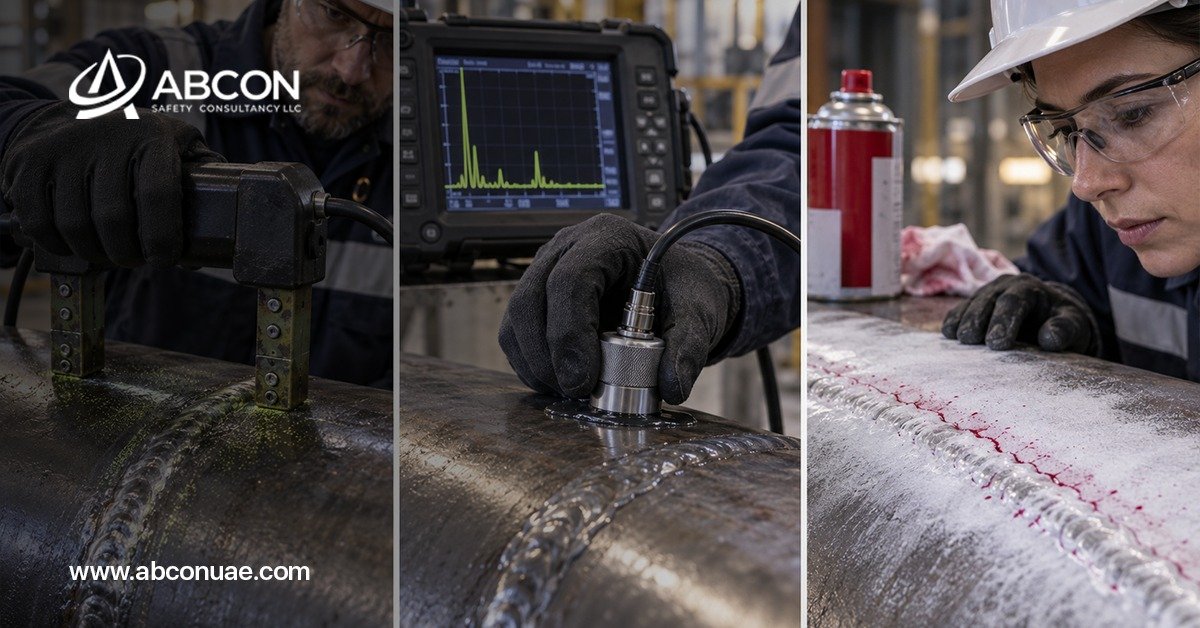
There is no single best method it depends on corrosion type and pipeline configuration. For internal corrosion and wall-thickness monitoring, Ultrasonic Testing (UT) and Guided Wave LRUT are most effective. For external corrosion on buried or insulated lines, Pulsed Eddy Current (PEC) can inspect through insulation without removal. Magnetic Flux Leakage (MFL) is preferred for storage tank floors.
How much does NDT inspection cost for oil and gas assets in the UAE?
Costs vary based on asset type, access difficulty, method, and mobilisation requirements. A standard UT weld inspection may cost a few hundred dirhams per weld joint. A full API 653 storage tank inspection can range from AED 50,000 to AED 500,000 depending on tank size and scope. The cost of a single avoided failure far exceeds most facilities' total annual inspection budget.
Can NDT inspection be carried out while the plant is operating?
Yes. Many NDT methods are designed for in-service inspection, including Guided Wave LRUT, Pulsed Eddy Current, Thermography, and many UT techniques. Some techniques such as radiography require safety exclusion zones, and certain access points may need short local shutdowns.
Ready to Protect Your UAE Oil & Gas Assets?
Get a tailored NDT inspection plan from certified engineers with deep ADNOC and UAE regulatory experience. Fast mobilisation. Detailed reporting. Full code compliance.