'/%3E%3Cpath d='M30 0v30M0 15h60' stroke='%23FFF' stroke-width='10'/%3E%3Cpath d='M30 0v30M0 15h60' stroke='%23C8102E' stroke-width='6'/%3E%3C/svg%3E)
Why Third-Party Lifting Equipment Inspection is Mandatory in UAE
A complete, regulation-backed guide for safety managers, project engineers, and HSE professionals operating in Dubai, Abu Dhabi, and across the UAE.
A complete, regulation-backed guide for safety managers, project engineers, and HSE professionals operating in Dubai, Abu Dhabi, and across the UAE.
1. What Is Third-Party Lifting Equipment Inspection?
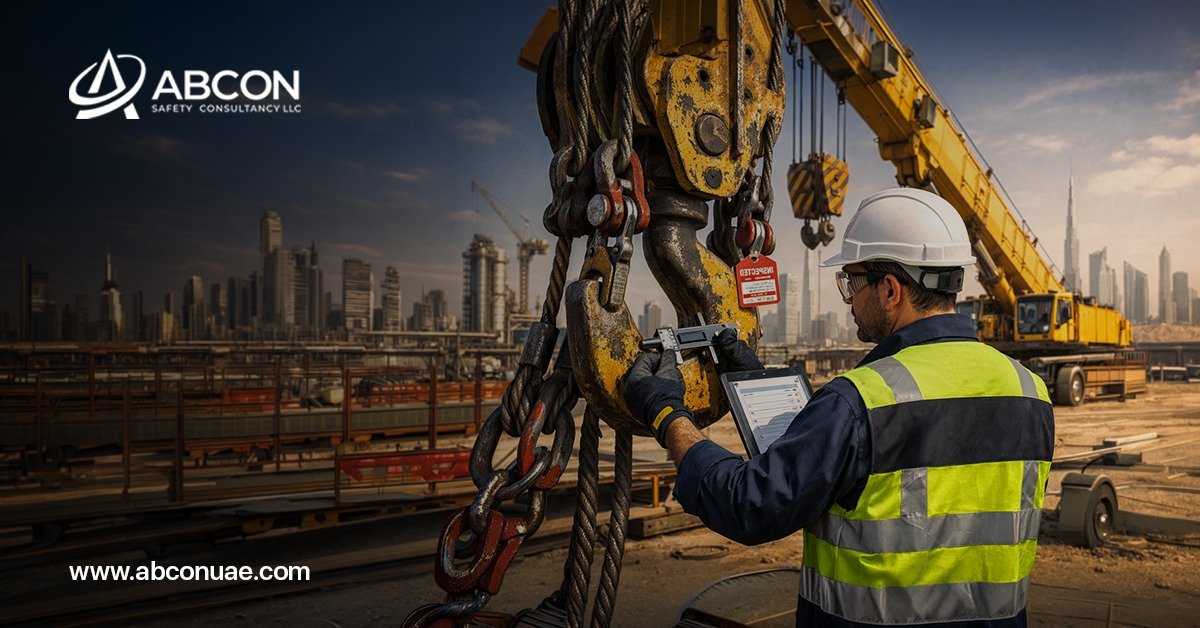
A third-party lifting equipment inspection is an independent, unbiased examination of lifting machinery and accessories conducted by a certified, accredited body that has no commercial interest in the equipment being assessed.
Unlike internal checks carried out by operators or site teams, third-party inspections are performed by qualified engineers who evaluate lifting equipment against national and international safety standards to determine whether it is safe, fit-for-purpose, and compliant with applicable regulations.
Third-Party vs. In-House Inspection: What's the Difference?
In-house inspection: Carried out by the site team or operator. Useful for daily/weekly checks but not recognised as compliant for regulatory purposes.
Manufacturer inspection: Performed by the OEM. Covers warranty and technical performance but is not independent.
Third-party inspection: Conducted by an accredited, neutral body. The only form of inspection that satisfies UAE regulatory requirements for lifting equipment certification.
2. Why Is It Legally Mandatory in the UAE?
The UAE has one of the most active construction and industrial sectors in the world. Cranes, hoists, forklifts, and rigging equipment are used daily across thousands of worksites in Dubai, Abu Dhabi, Sharjah, and beyond. Third-party lifting equipment inspection is mandatory for several interconnected reasons:
1. Legal Obligation Under UAE Federal and Emirate-Level Law
UAE Federal Law No. 8 of 1980 (Labour Law) and subsequent ministerial decrees require employers to maintain all work equipment in a safe and serviceable condition. Regulatory authorities including OSHAD (Abu Dhabi), Dubai Municipality (DM), and MOHRE mandate periodic third-party inspection as the mechanism for demonstrating compliance.
2. Prevention of Catastrophic Accidents
Lifting operations carry the highest risk of fatal workplace accidents. A crane collapse, dropped load, or sling failure can cause multiple casualties in seconds. Independent inspection identifies hidden defects fatigue cracks, corrosion, worn wire ropes, and overload damage that are invisible to the untrained eye.
3. Insurance and Contractual Requirements
Most UAE project contracts particularly in oil and gas, construction, and utilities require valid third-party inspection certificates as a condition of insurance coverage. Without them, equipment cannot legally operate on-site, and any accident voids the insurer's liability.
4. Protecting Workers' Rights
The UAE government's commitment to worker safety is codified in progressive HSE legislation. Mandatory third-party inspection is a direct mechanism for protecting workers under Article 91 of the UAE Labour Law.
3. Key UAE Regulations and Standards Governing Lifting Equipment Inspection
Regulation / Standard | Issuing Authority | Scope |
|---|---|---|
UAE Federal Law No. 8 of 1980 | MOHRE (Federal) | General workplace safety obligations for all employers |
OSHAD-SF — Technical Guideline 04 | OSHAD, Abu Dhabi | Mandatory in Abu Dhabi — lifting plans, equipment standards, inspection intervals |
Dubai Municipality Construction Safety Code | Dubai Municipality | Crane and lifting equipment use on all Dubai construction sites |
ADNOC HSE Standards (SP-1003) | ADNOC | All contractors and subcontractors in ADNOC facilities |
BS EN 13001 / BS 7121 | British Standards (adopted in UAE) | Technical design and testing standards for cranes |
ISO 9927-1 / FEM Standards | ISO / FEM (adopted in UAE) | Periodic inspection criteria for cranes in service |
ASME B30 Series | ASME (adopted in UAE) | Hoists, slings, and rigging hardware — widely used in UAE oil and gas |
4. What Lifting Equipment Requires Third-Party Inspection in the UAE?
Any equipment used to lift, lower, or suspend a load including people falls under UAE lifting equipment regulations.
Lifting Machinery
Mobile Cranes (all capacities)
Tower Cranes
Overhead Bridge Cranes
Gantry Cranes
Boom Trucks / Knuckle Boom Cranes
Forklifts and Telehandlers
Aerial Work Platforms (MEWPs)
Hoists (Chain, Wire Rope and Electric)
Monorails and Jib Cranes
Offshore Cranes and Davits
Vehicle-Mounted Lifts
Passenger / Materials Hoists
Lifting Accessories and Rigging Gear
Wire Rope Slings
Synthetic Web Slings (Flat and Round)
Chain Slings
Shackles (Bow and Dee)
Eye Bolts and Swivel Hoist Rings
Spreader Beams and Lifting Frames
Hooks and Safety Hooks
Turnbuckles and Tensioners
Grabs, Clamps and Magnets
Load Cells and Dynamometers
Custom Lifting Beams / Frames
Pallet Forks and Hook Blocks
5. How Often Must Lifting Equipment Be Inspected in the UAE?
Equipment Type | Minimum Inspection Interval | Additional Triggers |
|---|---|---|
Cranes (all types) | Every 6 months | After any incident, modification, or extended idle period |
Lifting Accessories (slings, shackles, etc.) | Every 6 months | Before first use on a new site, after overload, after visible damage |
Forklifts and Telehandlers | Annually (some sectors: 6 months) | After collision, overload, or attachment change |
MEWPs / Scissor Lifts / Boom Lifts | Every 6 months | After any structural repair or accident |
Passenger / Construction Hoists | Every 3 months | Before commissioning and after any safety incident |
Offshore Cranes (ADNOC Facilities) | Every 6 months | After storm, overload event, or structural modification |
6. What Does a Third-Party Lifting Equipment Inspection Cover?
A comprehensive third-party inspection is a multi-stage technical evaluation:
Step 1 — Documentation Review Verification of certificates of conformity (CoC), previous inspection records, load test certificates, maintenance logs, and operator qualifications.
Step 2 — Visual and Physical Examination Thorough visual check of all structural components boom sections, outriggers, hook blocks, wire ropes, sling bodies, shackle pins — for cracks, corrosion, deformation, and wear.
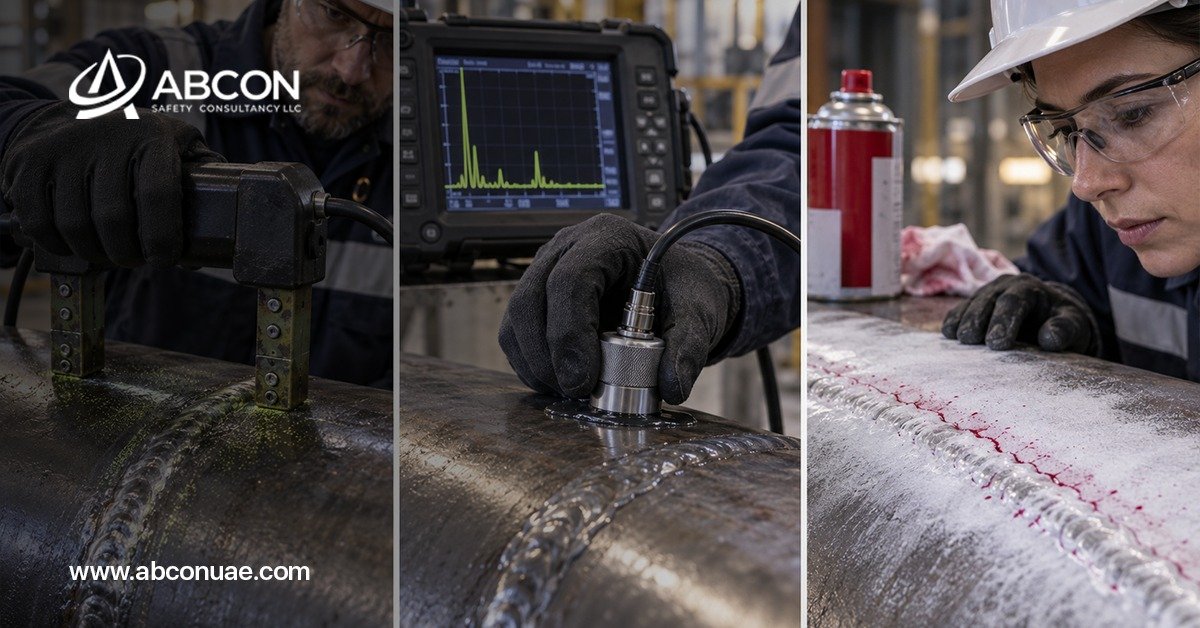
Step 3 — Non-Destructive Testing (NDT) Where Required Advanced techniques including magnetic particle inspection (MPI), dye penetrant testing (DPT), and ultrasonic testing (UT) to detect subsurface defects invisible to the naked eye.
Step 4 — Functional Testing and Load Testing Operational tests of all safety devices overload protection, limit switches, emergency stops, load indicators, and anti-two-block systems. Proof load testing where mandated or after major repair.
Step 5 — Structural Integrity Assessment Evaluation of welds, bolted connections, and load-bearing members against original design specifications and applicable standards (BS EN 13001, ASME B30, etc.).
Step 6 — Certification and Reporting Issuance of a formal inspection certificate pass, conditional pass, or fail along with a detailed technical report and recommended corrective actions.
7. Consequences of Non-Compliance in the UAE
Regulatory Penalties
Immediate stop-work orders issued by OSHAD, Dubai Municipality, or Ministry inspectors
Fines of AED 50,000 or more per violation, with repeat offences attracting higher penalties
Revocation of trade licences or project-specific approvals
Blacklisting from future government tenders in Abu Dhabi and Dubai
Legal and Criminal Liability
Under UAE Penal Law, if a worker is injured or killed due to non-compliant equipment, the site manager, company director, and HSE officer can face criminal prosecution
Civil lawsuits and compensation claims from injured workers or their families
Personal liability for decision-makers in the event of a fatality
Insurance and Commercial Impact
Insurance policies are void if an incident occurs with uninspected equipment
Project contracts can be terminated for cause
Loss of future contracts from clients who mandate compliance screening (ADNOC, DEWA, Emaar, etc.)
Operational and Reputational Damage
Project delays caused by stop-work orders can trigger liquidated damages clauses
Reputational damage that affects bidding capability for years
Loss of worker confidence and increased staff attrition
8. How to Choose a Qualified Third-Party Inspection Body in the UAE
What to Look For
ENAS Accreditation — Confirm the provider is accredited under ISO/IEC 17020 by the Emirates National Accreditation System (ENAS). This is the gold standard for UAE-based inspection bodies.
Sector-specific experience — Offshore, construction, and industrial cranes require different expertise. Verify the inspector's track record in your sector.
Qualified inspectors — Look for LEEA-certified engineers, Level III NDT inspectors (BINDT/ASNT), and OPITO-certified personnel for offshore work.
Comprehensive documentation — Certificates must be accepted by OSHAD, Dubai Municipality, ADNOC, and other relevant authorities.
Geographic coverage — Ensure the company can service both Dubai and Abu Dhabi so all your sites are covered under one account.
Turnaround time — Fast certificate issuance (ideally within 24–48 hours) is essential in active project environments to avoid operational disruption.
9. Frequently Asked Questions
Q: Is a manufacturer's certificate enough to operate lifting equipment in the UAE?
No. A manufacturer's CE certificate confirms the equipment met design standards at point of manufacture. UAE regulations require periodic in-service third-party inspection to confirm ongoing fitness-for-use. Both documents must be maintained.
Q: Who is responsible for ensuring lifting equipment is inspected on a construction site?
The Primary Contractor holds ultimate responsibility, but this is typically passed down contractually to subcontractors and equipment owners. All parties share duty-of-care obligations under UAE law.
Q: Can I use an inspection certificate issued in another country?
Generally, no. UAE regulatory authorities require certificates issued by ENAS-accredited UAE-based bodies, or by internationally recognised bodies specifically approved by the relevant UAE authority. Always verify acceptance before relying on an overseas certificate.
Q: What happens if equipment fails its third-party inspection?
The inspector issues a detailed report specifying defects found. Equipment must be taken out of service immediately and must not be used until deficiencies are rectified and re-inspection confirms it is safe. Operating equipment with a failed certificate is a criminal offence in the UAE.
Q: Are lifting accessories (slings, shackles) subject to the same rules as cranes?
Yes. Lifting accessories are classified as lifting equipment under UAE regulations and require the same periodic third-party inspection. Given their vulnerability to damage, rigorous inspection of accessories is arguably more important than for the cranes themselves.
Q: How long is a UAE third-party lifting equipment inspection certificate valid?
Typically 6 months for most lifting machinery and accessories. Passenger hoists may require 3-month cycles. Certificates may be invalidated earlier if the equipment is involved in an incident, modified, or transferred to a new site.
Q: Does third-party inspection cover load testing?
Load testing is mandatory for new equipment entering service, after major repairs, and after structural modifications. Routine periodic inspections may or may not include proof load testing depending on the equipment's history, condition, and the applicable regulatory requirement.
Need Third-Party Lifting Equipment Inspection in Dubai or Abu Dhabi?
ABCON Safety Consultancy LLC provides third-party inspection services for all types of lifting equipment cranes, hoists, forklifts, rigging gear, and more across Dubai, Abu Dhabi, and the wider UAE.