'/%3E%3Cpath d='M30 0v30M0 15h60' stroke='%23FFF' stroke-width='10'/%3E%3Cpath d='M30 0v30M0 15h60' stroke='%23C8102E' stroke-width='6'/%3E%3C/svg%3E)
NDT Inspection Methods Explained: MPI, UT & PT for UAE Industries
NDT inspection — MPI, Ultrasonic Testing, and Penetrant Testing helps UAE industries detect cracks, corrosion, and internal flaws in equipment without shutting it down. It's a legal requirement in Dubai and Abu Dhabi across construction, oil and gas, and manufacturing. ABCON Safety Consultancy is EIAC accredited and ready to help.
NDT inspection — MPI, Ultrasonic Testing, and Penetrant Testing helps UAE industries detect cracks, corrosion, and internal flaws in equipment without shutting it down. It's a legal requirement in Dubai and Abu Dhabi across construction, oil and gas, and manufacturing. ABCON Safety Consultancy is EIAC accredited and ready to help.
Non-destructive testing NDT is the backbone of industrial integrity management across the UAE. From oil and gas pipelines in Abu Dhabi to structural steel on Dubai high-rises, NDT allows engineers to detect cracks, corrosion, and internal flaws in equipment and structures without damaging or shutting them down.
For businesses operating in the UAE's construction, manufacturing, oil and gas, marine, and utilities sectors, understanding the three most widely used NDT methods — Magnetic Particle Inspection (MPI), Ultrasonic Testing (UT), and Penetrant Testing (PT) is essential for making informed compliance decisions and protecting assets and people.
This guide explains each method clearly, outlines when and why each is used, and covers what UAE regulations require.
What Is NDT and Why Does It Matter in the UAE?
Non-destructive testing is a range of inspection techniques used to evaluate the condition of materials, components, and structures without causing damage. Unlike destructive testing which requires cutting, breaking, or otherwise compromising the asset NDT allows the asset to remain in service while being assessed.
In the UAE, the combination of extreme heat, humidity, salt air, and high-intensity industrial operations accelerates corrosion, metal fatigue, and weld degradation significantly faster than temperate climates. This makes regular, structured NDT inspection not just a regulatory requirement but a genuine operational necessity.
Under UAE Federal Law No. 8 of 1980 on labour and occupational safety, and the technical standards enforced by Dubai Municipality, Abu Dhabi Municipality (ADM), and sector regulators including ADNOC, NDT inspection is required across a wide range of assets in construction, oil and gas, utilities, and manufacturing.
The internationally recognised standard governing NDT inspection bodies is ISO/IEC 17020 the same standard under which EIAC accredits third party inspection bodies in Dubai.
Method 1: Magnetic Particle Inspection (MPI)
What is MPI?
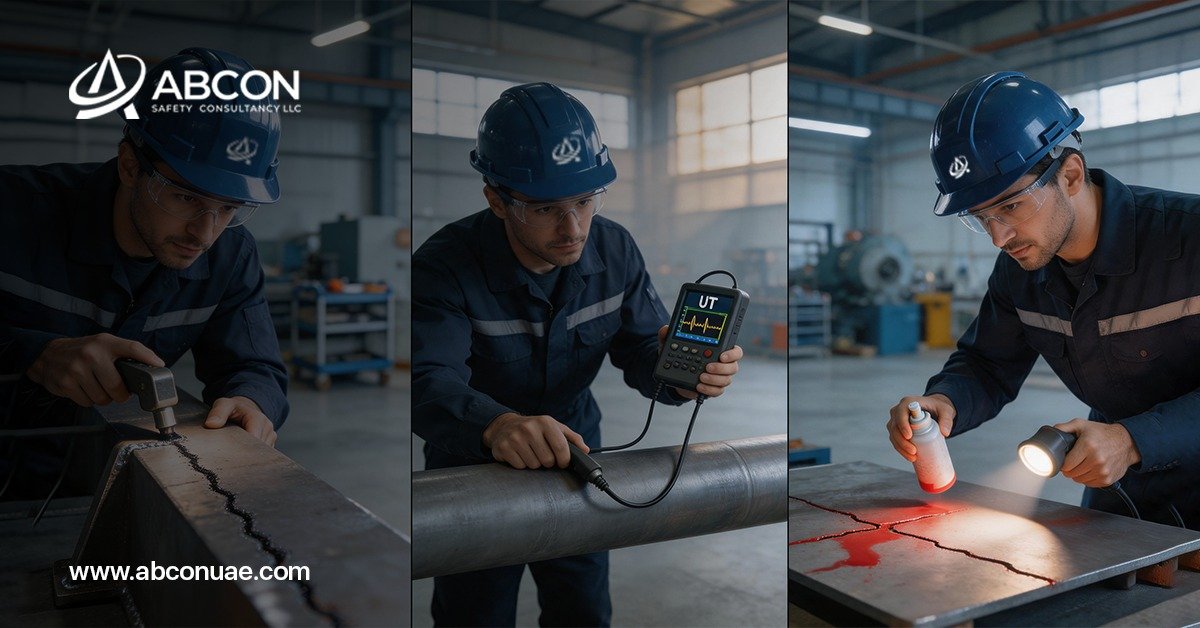
Magnetic Particle Inspection (MPI) also called Magnetic Particle Testing (MT) is an NDT method used to detect surface and near-surface defects in ferromagnetic materials (materials that can be magnetised, such as carbon steel, stainless steel, and cast iron).
A magnetic field is applied to the component using a yoke, prod, or coil. Fine magnetic particles either dry powder or suspended in liquid are then applied to the surface. Where a defect exists, the magnetic field is disrupted, causing particles to cluster visibly at the defect location.
When is MPI used in UAE industries?
MPI is particularly valuable for:
Crane structures and lifting equipment — detecting fatigue cracks at welds and high-stress connection points
Structural steel — weld quality verification on construction frames, bridges, and offshore platforms
Pipeline girth welds — used extensively in oil and gas across Abu Dhabi and Dubai
Pressure vessel shell plates and nozzle welds — checking for stress corrosion cracking, common in the UAE's high-humidity coastal environment
Forged components — hooks, shackles, and rigging hardware
Key MPI facts
Only works on ferromagnetic materials not applicable to aluminium, copper, or non-magnetic stainless steel
Detects defects down to near-surface depth (typically up to 2–3mm below surface)
Fast, portable, and cost-effective for large surface area coverage
Results are immediately visible no complex data processing required
Method 2: Ultrasonic Testing (UT)
What is Ultrasonic Testing?
Ultrasonic Testing (UT) uses high-frequency sound waves transmitted into a material to detect internal flaws, measure wall thickness, and assess weld integrity all without cutting or disassembling the component.
A transducer (probe) is placed on the surface of the component and emits ultrasonic pulses. These pulses travel through the material and reflect back when they encounter a boundary either the far wall or an internal defect. The time taken for the pulse to return and the amplitude of the reflection allow the inspector to identify and size internal discontinuities with precision.
When is UT used in UAE industries?
UT is the method of choice for:
Pressure vessels and storage tanks — measuring wall thickness to detect corrosion thinning, critical in UAE petrochemical and desalination facilities
Pipeline inspection — detecting internal corrosion, pitting, and weld defects without excavation
Structural welds on cranes, MEWPs, and lifting equipment — assessing internal weld integrity before certification
Ship hull plating — ultrasonic thickness gauging (UTG) is standard practice in Dubai and Fujairah ports
Castings and forgings — detecting internal voids and inclusions before commissioning
Advanced UT methods used in UAE
Modern NDT practice in the UAE frequently employs advanced UT variants:
Phased Array UT (PAUT) — uses multiple elements to steer and focus ultrasonic beams, producing detailed cross-sectional imaging of welds and components
Time of Flight Diffraction (TOFD) — highly accurate for measuring crack depth and sizing internal weld defects
Ultrasonic Thickness Gauging (UTG) — single-point wall thickness measurement, widely used for routine corrosion monitoring
Key UT facts
Detects internal defects goes beyond surface and near-surface limitations of MPI and PT
Works on metals, composites, plastics, ceramics, and concrete
Highly accurate can size defects to fractions of a millimeter
Requires trained, certified operators (minimum BINDT PCN Level 2 or ASNT Level II)
Method 3: Penetrant Testing (PT)
What is Penetrant Testing?
Penetrant Testing (PT) also called Dye Penetrant Inspection (DPI) or Liquid Penetrant Testing (LPT) is an NDT method used to detect surface-breaking defects on any non-porous material, including metals, ceramics, and plastics.
A coloured or fluorescent dye penetrant is applied to the clean surface and allowed to dwell seeping into any surface cracks or pores by capillary action. Excess penetrant is removed, and a developer is applied. The developer draws the trapped penetrant back out of the defect, making it visible as a clear indication on the surface.
When is PT used in UAE industries?
PT is widely applied across:
Aluminium and non-ferromagnetic materials — where MPI is not applicable
Weld inspection on non-magnetic stainless steel — common in food processing, pharmaceutical, and marine applications in the UAE
Turbine blades, impellers, and castings — detecting fatigue cracks in rotating equipment at power and desalination plants
Aerospace components — PT is a standard method at UAE MRO (maintenance, repair and overhaul) facilities
Valve and fitting inspection — surface crack detection before and after pressure testing
Key PT facts
Works on any non-porous material — broader material applicability than MPI
Only detects surface-breaking defects — no subsurface capability
Low equipment cost and relatively simple procedure
Results depend heavily on correct surface preparation and dwell time — poor technique produces unreliable results
Choosing the Right NDT Method: Quick Reference
Method | Best For | Material | Defect Type | Depth |
|---|---|---|---|---|
MPI | Ferromagnetic metals, welds, cranes | Carbon steel, stainless (magnetic) | Surface + near-surface | Up to 2–3mm below surface |
UT | Internal integrity, wall thickness | All metals, composites, plastics | Internal + surface | Full material thickness |
PT | Non-ferromagnetic materials, castings | Any non-porous material | Surface-breaking only | Surface only |
NDT Inspection Requirements for UAE Industries
UAE regulatory frameworks require NDT inspection across the following sectors and asset types:
Construction and infrastructure — Structural weld inspection on cranes, lifting equipment, and high-rise structural steel is mandated under Dubai Municipality and TRAKHEES regulations. MPI and UT are the primary methods required.
Oil and gas — ADNOC supplier requirements mandate NDT inspection in line with ASME, API, and AWS standards. UT, MPI, and PT are all routinely required for pressure vessels, pipelines, and process equipment across Abu Dhabi.
Marine — Dubai and Fujairah ports operate under IACS classification society requirements (ABS, BV, DNV, LR). Hull plating, welds, and structural members require UT thickness gauging and MPI at defined survey intervals.
Manufacturing and fabrication — Weld procedure qualification and production weld inspection under ISO 3834 and AWS D1.1 require NDT sign-off before components are released for service.
NDT inspection bodies carrying out compliance inspections in Dubai must be EIAC accredited under ISO/IEC 17020. ABCON Safety Consultancy is EIAC accredited and provides certified NDT inspection across Dubai and Abu Dhabi. View our full scope of accreditations at abconuae.com/accreditations.
Why the UAE's Climate Makes NDT More Critical Than Most Markets
The UAE's environment is among the most aggressive for industrial assets in the world:
Extreme heat — ambient temperatures above 45°C accelerate thermal fatigue and stress cycling in structural components
High humidity and salt air — coastal operations in Dubai, Abu Dhabi, and Fujairah face accelerated corrosion rates significantly higher than inland environments
Desert dust and particulate — abrasive contamination accelerates surface wear on seals, welds, and coatings
High operational intensity — UAE construction and energy sectors operate at some of the highest utilization rates globally
These factors mean that the inspection intervals that apply in European or North American contexts are often insufficient for UAE conditions. Competent NDT inspection carried out by accredited bodies using qualified personnel is not just a compliance obligation in the UAE. It is an operational necessity.
Frequently Asked Questions
What is NDT inspection and why is it used in UAE industries?
NDT (Non-Destructive Testing) is a range of inspection techniques that detect defects in materials and structures without causing damage. It is widely used in UAE construction, oil and gas, marine, and manufacturing sectors to ensure equipment integrity, meet regulatory requirements, and prevent failures in the region's harsh operating environment.
What is the difference between MPI, UT, and PT?
MPI detects surface and near-surface defects in ferromagnetic metals using magnetic fields and particles. UT uses sound waves to detect internal defects and measure wall thickness across most materials. PT uses dye penetrant to reveal surface-breaking defects on any non-porous material. Each method is suited to different materials and defect types — they are often used together for comprehensive inspection coverage.
Is NDT inspection mandatory in Dubai and Abu Dhabi?
Yes. Dubai Municipality, TRAKHEES, JAFZA, and Abu Dhabi Municipality regulations require NDT inspection for structural welds, pressure vessels, lifting equipment, and pipelines. ADNOC supplier requirements mandate NDT in line with ASME and API standards across Abu Dhabi's oil and gas sector.
Which NDT method is used for weld inspection in UAE?
MPI and UT are the most commonly specified methods for weld inspection in UAE construction and oil and gas. MPI detects surface weld cracks quickly across large areas; UT provides deeper assessment of internal weld integrity. PT is used for non-magnetic materials including austenitic stainless steel welds.
What qualifications should NDT inspectors hold in the UAE?
NDT inspectors in the UAE should hold minimum Level 2 certification under internationally recognised schemes — primarily BINDT PCN (Personnel Certification in NDT) or ASNT (American Society for Non-Destructive Testing). The inspection body should be EIAC accredited under ISO/IEC 17020 for the specific NDT methods being applied.
How do I find an EIAC accredited NDT inspection company in Dubai?
Search the official EIAC directory at eiac.gov.ae/directory or contact ABCON Safety Consultancy directly at abconuae.com — we are EIAC accredited and serve clients across Dubai and Abu Dhabi.
How often should NDT inspection be carried out?
Frequency depends on the asset type, regulatory requirement, and operating conditions. Lifting equipment typically requires annual third-party NDT. Pressure vessels are inspected per their design standard (ASME, PED). Pipelines and structural components are inspected based on risk assessment and survey schedules. In the UAE's aggressive climate, shorter intervals than international norms are often warranted.